The Build America, Buy America Act (BABA) aims to ensure taxpayer funds for federal infrastructure projects support domestic manufacturing, strengthen local supply chains, and create American jobs.
That’s good news for anything American-made, right? Yes, but there’s a catch: qualifying requires detailed documentation of material origin and manufacturing location, far more extensive than anything some shops may have encountered before.
BABA applies when infrastructure projects use, or want to use, federal financial assistance. It does not automatically govern every purchase involving federal dollars. Direct federal acquisitions, including many Department of Defense purchases, generally fall under the Buy American statute, the Federal Acquisition Regulation, and sometimes agency-specific rules instead.
Important disclaimer: BABA and related requirements are complex and may be affected by agency, state, local, and contract-specific rules. This post is for general information only. Do not use it to bid or certify a project without reviewing the official award documents and obtaining qualified advice.
What is BABA Intended to Accomplish?
BABA is not a new concept; it builds on earlier domestic-preference legislation. But it applies specifically to federal infrastructure awards. Enacted as part of the Infrastructure Investment and Jobs Act (IIJA), it aims to direct more public-infrastructure spending toward U.S. production, as described below:
|
Congressional objective |
Desired outcome |
|
Support U.S. manufacturing and workers. |
Federal infrastructure spending should circulate through U.S. plants, payrolls, and communities. |
|
Strengthen domestic supply chains. |
Public spending can create steadier demand for domestic materials and production capacity. |
|
Improve economic resilience and national security. |
Greater domestic capacity can reduce exposure to overseas disruption and supply shortages. |
The Office of Management and Budget’s (OMB) 2023 final guidance echoes those objectives. It describes BABA as a way to create demand for domestic goods, sustain U.S. manufacturing, support manufacturing employment, strengthen national security, and give the market clearer signals about what federally assisted infrastructure projects need.
What Counts as Infrastructure?
Under 2 CFR Part 184, infrastructure includes roads, highways, bridges, public transportation, dams, ports, rail, airports, water and wastewater systems, electrical transmission, utilities, broadband, buildings, real property, and energy facilities, including EV charging. The list is illustrative rather than exhaustive, and agencies are told to consider whether a project serves a public function.
BABA also applies to more than new construction. An infrastructure project can include construction, alteration, maintenance, or repair. That is why repair parts, replacement fabrications, and upgrade assemblies may be covered; prime opportunities for water jet fabricators to become involved.
The Three Domestic Tests
Three categories determine how an item is classified based on its condition when it arrives at the work site. It then needs to meet the domestic test for that category:
|
Category |
Domestic test |
water jet example |
|
Iron or steel products |
Iron and steel exceed 50% of component cost, and all manufacturing processes, from initial melting through coating, occur in the U.S. |
A custom steel bracket or plate. |
|
Manufactured products |
The product is manufactured in the U.S., and domestic components account for more than 55% of total component cost unless another applicable standard governs. |
A pump skid, control cabinet, or integrated assembly. |
|
Construction materials |
The manufacturing processes specified for the material in 2 CFR 184.6 occur in the U.S. |
A water jet-cut aluminum plate is delivered as the item for installation. |
The FHWA Manufactured-Products Transition
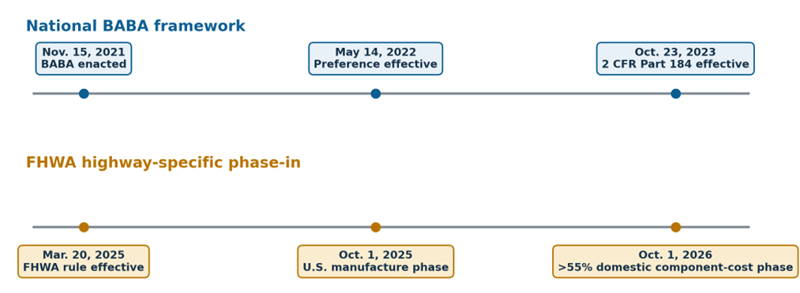
October 1, 2026, is an important deadline, but it does not mark a nationwide increase in the BABA domestic-content threshold. It applies specifically to manufactured products permanently incorporated into federal-aid highway projects.
For projects obligated (approved for federal funding) on or after October 1, 2025, covered manufactured products must be manufactured in the United States. For projects obligated on or after October 1, 2026, those products must also contain U.S.-made components accounting for more than 55% of total component cost. Cost is based on several factors, including material, labor, assembly, and transportation, ignoring any profit margin.
Before quoting or certifying a product, verify the funding program, obligation date, product classification, applicable waivers, and documentation requirements as the October 2026 deadline has already passed.
Made in the USA is a Separate Standard
The Federal Trade Commission’s (FTC) Made in USA Labeling Rule governs unqualified U.S.-origin claims made in product labeling and advertising. It generally requires final assembly or processing, all significant processing, and all or virtually all components to originate in the United States. BABA uses different procurement tests. Compliance with one standard does not necessarily establish compliance with the other.
What Does All This Mean to Your Water Jet Fabrication Shop?
The short answer is documentation, and lots of it. Verbal assurances or generic supplier statements will not satisfy compliance evidence requirements. A shop may need traceable mill certificates, heat and lot records, process-location statements, inspection records, and supplier certifications. In addition, the shop must also follow retention guidelines to respond to future inquiries.
Requirements flow down the contracting chain; compliance evidence flows back up it; and materials and finished parts physically move toward the project site.
The flow-down should reach the shop before it quotes or accepts the order. Obtain origin and process evidence before the first cut and confirm the exact certification route in the award documents, specifications, and purchase order.
|
Direction |
What moves |
Bracket example |
|
Downstream |
Contract clauses, specifications, required forms, and record-retention duties. |
The purchase order tells the shop that the bracket is covered and identifies the required proof. |
|
Upstream |
Mill certificates, process-location records, lot traceability, and supplier certifications. |
The mill, shop, welder, and coater contribute records to the package returned to the buyer. |
|
Toward the site |
The material and finished parts themselves. |
Plate moves to the shop; the finished bracket moves to an assembler or the project. |
Yes, the evidence side can sound daunting. But producers that can provide reliable traceability may enjoy a real competitive advantage.
Two Practical Examples
The following examples show two domestic-content situations a water jet shop might encounter: one under BABA and one under a defense contract governed by different rules.
Example A: water jet-Cut Pole-Mounted Transformer Bracket
|
Question |
Illustrative compliant fact pattern |
|
What applies? |
A federally assisted electric-distribution project buys the finished steel bracket for permanent attachment to a utility pole. Iron and steel exceed 50% of component cost, so it is classified as an iron or steel product. |
|
What must be domestic? |
All manufacturing processes for the iron and steel, from initial melting through rolling, water jet cutting, forming, welding, and coating, occur in the United States. |
|
What proves it? |
A lot-specific mill test report is linked to the shop’s fabrication record and to any welding or coating records supplied with the shipment. |
|
Important caveat |
If the bracket reaches the work site as part of a complete transformer or other assembly, the finished assembly may instead be classified as the manufactured product. |
Example B: water jet-Cut Specialty-Metal Drone Bracket
|
Question |
Illustrative contract-compliant fact pattern |
|
What applies? |
A DoD prime contractor orders a titanium-alloy sensor bracket and flows DFARS 252.225-7009 into the purchase order. This is defense-contract compliance, not ordinary BABA compliance. |
|
What must be sourced? |
The specialty metal that was melted or produced in the United States, an outlying area, or a qualifying country, subject to the contract clause and any applicable exception. |
|
What proves it? |
The material certificate identifies the alloy, heat or lot, producer, and melt or production country. The shop preserves traceability through cutting, inspection, and shipment. |
|
Important caveat |
Domestic water jet cutting alone does not cure a noncompliant melt origin. FAR, DFARS, COTS, and other contract-specific exceptions may change the analysis. |
The Strategic Importance of Domestic Production
COVID-19 demonstrated how vulnerable supply chains can become under unusual conditions. Moving more production to American soil can reduce exposure to overseas disruptions, shorten transportation routes, and strengthen domestic production capacity. It cannot eliminate every interruption, but it can give manufacturers more options when global supply chains tighten.
Local production can also reduce lead times, improve access to spare parts, limit some tariff exposure, and make it easier for engineers, manufacturers, and fabricators to solve problems together.
Perhaps most importantly, domestic manufacturing capability has been and will continue to be a centrally enabling factor in our country’s continued prosperity. Buying American made products, including the capital equipment that is used in production processes, is critical to maintaining and growing this strategic area for the generations to come.
Talk to Jet Edge
Jet Edge has designed and built ultra-high-pressure water jet systems in St. Michael, Minnesota, since 1984. It manufactures both the intensifier pumps and motion systems in-house, an unusual combination that gives customers one OEM for the complete cutting system, parts, and support.
If you are evaluating a water jet for domestic production, reach us online or call toll-free in the U.S. at 1-800-538-3343 or internationally at +1-763-497-8700.
Acronyms Used in This Article
|
Term |
Meaning |
Term |
Meaning |
|
BABA |
Build America, Buy America Act |
CFR |
Code of Federal Regulations |
|
COTS |
Commercially available off-the-shelf |
DFARS |
Defense Federal Acquisition Regulation Supplement |
|
DoD |
U.S. Department of Defense |
FAR |
Federal Acquisition Regulation |
|
FHWA |
Federal Highway Administration |
FTC |
Federal Trade Commission |
|
IIJA |
Infrastructure Investment and Jobs Act |
OMB |
Office of Management and Budge |
Acronyms Used in This Article
- 2 CFR Part 184: Buy America Preferences for Infrastructure Projects
- 23 CFR 635.410: Current FHWA Buy America Requirements
- FHWA: Buy America Construction Program Guide
- OMB Memorandum M-24-02: BABA Implementation Guidance
- FTC: Complying with the Made in USA Standard
- FAR 25.101: Buy American Domestic-Content Thresholds
- DFARS 252.225-7009: Restriction on Certain Specialty Metals
Check Out Our Digital Brochure!
Since 1984, Jet Edge has been designing and manufacturing Ultra-High-Pressure Water jet technology that doesn't back down. Our systems are used around the world in a broad range of industries from the world's leading airlines, to automotive, aerospace and industrial manufacturers, and machine job shops.
To learn more about the Jet Edge difference, our water jet motion systems, pumps and much more, click the button "Download Brochure" to get it now!