
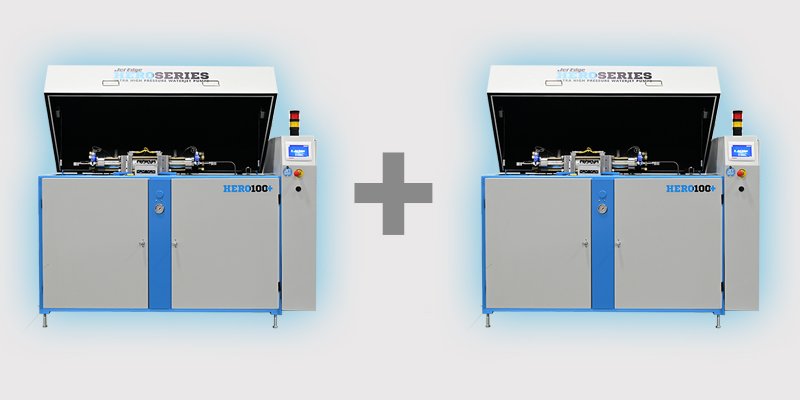
You manage the operations of a precision manufacturing company. Your shop floor includes an impressive range of processes and capabilities, including water jets. So, what is the first thing that crosses your mind about your day ahead when your feet first hit the floor every morning?
Our customers have repeatedly told us the most common thought is, “What’s going to keep us from delivering on our commitments today, and how do I get ahead of it?”
If you’ve been there, then this blog is for you, as we introduce one exceptionally effective solution to this challenge – creating redundancy in mission-critical systems. In this article, we’ll explore the benefits of pump redundancy for your water jets, as well as the factors you should weigh if you are considering this approach.
Who Should Consider a High-Pressure Pump Redundancy Strategy?
While it is not for everyone, there are many types of operations where redundancy is a very important advantage. In particular, it is critical for those who:
- Rely on their waterjet systems as a cornerstone of their operations – any disruption will have a significant ripple effect downstream.
- Process very high-value components – an interrupted cycle can mean very significant scrap loss.
- Run extremely long cycle jobs – given the extremely long run times, the likelihood of maintenance need occurring within a cycle naturally increases.
- Support critical infrastructure / operations – in some environments, the water jet may not be utilized near 100%, however because it is used for supporting critical infrastructure, every job that comes through the machine is incredibly urgent.
- Strive to provide world-class capabilities – emphasis is placed on reducing and eliminating all potential roadblocks for production.
What Does Up-Time Mean to You, and What Impacts It?
To most operations managers, uptime has a simple definition: every tool is available when needed, every time it is required. Uptime is also one of, if not the most, crucial contributors to a healthy ROI. When a tool can’t run, you immediately face the following consequences:
- Lost production time and reduced throughput.
- Higher costs from increased scrap loss, restarting production lines, etc.
- Missed delivery commitments that lead to increased customer dissatisfaction.
- Loss of contracts in critical industries like aerospace, defense, and medical, where frequent delays are unacceptable.
- Develop a reputation for unreliable performance.
So, what are the foundations for maximum uptime? When it comes to the most complex precision cutting tools, including water jets, uptime relies on several factors:
- Start by selecting equipment designed for extreme durability and demanding use cases.
- Perform routine and preventive maintenance as prescribed.
- Adopt and use visual inspection and predictive monitoring tools.
- Ensure all operators are fully trained and receive refreshers as needed.
If you do all these things right, you’ll enjoy maximum uptime, enabling you to meet production schedules and product delivery commitments. However, even in an ideal world, unforeseen and unexpected events can still occur. That’s where a redundancy strategy, specifically, pump redundancy, can save the day.
What is Water Jet Pump Redundancy?
As the name suggests, pump redundancy involves configuring your water jet cutting system with two or more intensifier pumps. The pumps can operate in parallel or in a standby arrangement, as described below:
- Parallel operation means two or more intensifier pumps share a common discharge header, with each contributing flow as needed.
- Standby redundancy means a backup pump remains idle until it is switched, either manually or automatically, into active service.
Parallel Operation
In a parallel operation approach, there is an additional choice to consider whether the quantity and size of pumps are specified to achieve the total nominal output required, or if they are sized to achieve a full redundant capacity, or something in between.
Using Jet Edge equipment as an example, a system with a total demand of 2 gallons per minute (GPM) could be supplied by two (2) Hero50 Intensifier Pumps (total output 2.2 GPM), which is approximately the nominal output requirement. If one of these pumps goes down, the system can still run, but at reduced output capacity.
For a more critical setting, this system could be supplied with two (2) Hero100 Intensifier Pumps for full redundant capacity. In this case, under normal operation each pump will be running at approximately 50% of its rated capacity, and in the event of an outage of one of the pumps, the other unit continues operation (now at approximately 100% of its rated capacity) and total output capacity of the system is maintained.
Standby Redundancy
In a standby redundancy operation, think of the redundant pump as you would an emergency backup generator, where it remains idle under normal conditions, and is only activated when the primary system has an outage. Again, in this situation, sizing of the backup intensifier pump can be chosen as a smaller capacity unit (provide continuity of operation but at a reduced capacity) or full redundancy capacity (provide continuity and at nominal maximum output capacity).
In this standby approach, just as backup generators can be set up in cold standby (manually start) or hot standby (automatic cutover), water jet pumps can be similarly configured. It should be noted, however, that the automatic cutover of an ultra-high-pressure system requires careful engineering design and execution. The following table illustrates the requirements for each methodology to ensure successful operation:
|
Requirement |
Automatic Cutover |
Manual Cutover |
|
Control system |
PLC or integrated pump controller with failover logic, real-time monitoring of pressure, flow, vibration, etc. |
Basic operator controls (switches, HMI commands) with no automated logic. |
|
Failure detection |
Continuous sensing with thresholds (e.g., pressure drop, fault code) that trigger automatic switchover. |
The operator must observe alarms, gauges, or any cut performance issues, then decide to switch. |
|
Valve sequencing |
Automated valve actuation and interlocks to isolate the failed pump and bring the standby pump online smoothly. |
The operator manually adjusts valves, isolation, and bleed-down before engaging backup. |
|
Response time |
Near-instantaneous (seconds), minimizing cut interruption. |
Minutes or longer, depending on operator response and procedures. |
|
Operator involvement |
Minimal; the system manages the transition and notifies the crew. |
High; operators must be trained and available at the moment of failure. |
|
Risk of pressure shock |
Low if appropriately engineered (controlled ramp-up/down). |
Low if individuals are trained on appropriate procedures. |
|
Cost & complexity |
Higher: requires additional sensors, PLC logic, automated valves, and safety interlocks. |
Lower: relies on existing human oversight and manual hardware. |
|
Maintenance requirement |
Controllers, sensors, and actuators require periodic calibration/testing. |
Focus on mechanical valves and operator training/checklists. |
|
Operational reliability |
More consistent and predictable switchover; best for mission-critical uptime. |
Dependent on human factors (training, availability, judgment). |
What are the Advantages of Redundant Water Jet Pumps?
The primary advantage of pump redundancy is straightforward: it protects against unexpected pump failure and downtime. Even if the backup pump can’t deliver full capacity (in load-sharing arrangements), it keeps production running until the failed pump is repaired.
Here’s a shortlist of additional advantages:
- Maintenance Flexibility: perform service on one pump without stopping production.
- Load Sharing: multiple pumps can run together to reduce wear, extending component life.
- Scalability: add more cutting capacity without replacing the entire system.
- Increase client confidence: reassure sensitive customers that your operation is configured for maximum uptime.
- Operational continuity: If one pump in a load sharing configuration fails, output can still continue.
- Peace of mind: know you have actively reduced the risk and potential impact of equipment downtime.
TIP: Always Remember to Exercise Your Pumps
Just like backup generators, redundant pumps must be run regularly for many reasons:
- Keep an oil film on moving parts to reduce start-up wear and tear.
- Circulating hydraulic fluid to prevent varnish buildup, sludge settlement, and air entrainment.
- Keep high-pressure check and direction valves from sticking.
- Prevent the redundant pump from “taking a set.”
- Confirm gaskets, fittings, and high-pressure tubing integrity under operating pressure.
- Validate that the pump and all its supporting components operate as expected.
What is the Real-World Impact on Up-Time When Using Redundant Pumps?
In a single-pump system, both planned pump maintenance and unplanned failure brings production to a complete stop until maintenance or repairs are completed. With a redundant pump, production can continue, and the potential interruption can be minimized or eliminated completely.
For many shops, the ability to continue production, even at a reduced rate, is decisive. Redundancy can raise uptime significantly, with some operations achieving close to 100%. This is an serious investment toward protecting two of the most important elements for your business: your revenue and your reputation. Maintaining throughput preserves revenue (and reduces costs), while unfailingly meeting delivery commitments strengthens your reputation as a reliable supplier. In today’s competitive landscape, both of these are decisive advantages.
Additional Questions to Ask Regarding the Cost/Benefit Analysis of Pump Redundancy
We recommend a need and opportunity assessment as the basis of a decision regarding a redundant pump. Here are a few questions to guide your process.
- How often have you experienced downtime from a failed intensifier pump?
- What is the ripple effect that comes from downtime? What is the magnitude of the direct and indirect costs of downtime?
- Considering the multi-decade useful life of these intensifier pumps, how many times over would the investment for a redundant setup payback?
- What is the reputational impact of equipment downtime?
- Would redundancy help win contracts in industries requiring high availability?
- How would a redundant system that maximizes uptime improve the quality of life for you and your team that already has enough challenges to manage?
Naturally, your situation will have additional considerations, but we have found these above to be important in nearly every case.
Implementing Pump Redundancy as Part of Your Up-Time Strategy
Pumps are an essential part of a comprehensive uptime strategy, but they aren’t the only consideration. Controls, spare part strategies, proactive and predictive maintenance, supply chain management, remote monitoring, training, and other factors can also be critical. We’ll examine these in future posts.
Talk To Jet Edge about High-Pressure Intensifier Pump Redundancy
We encourage everyone who is considering this approach and wants to discuss it with greater detail about your specific situation to contact us. With our extensive expertise in application development, engineering, and industry-specific experience, we are well-positioned to support your decision-making process. Call us at 1-800-538-3343 (1-763-497-8700 Internationally) or complete our online form today.

Check Out Our Digital Brochure!
Since 1984, Jet Edge has been designing and manufacturing Ultra-High-Pressure Water jet technology that doesn't back down. Our systems are used around the world in a broad range of industries from the world's leading airlines, to automotive, aerospace and industrial manufacturers, and machine job shops.
To learn more about the Jet Edge difference, our water jet motion systems, pumps and much more, click the button "Download Brochure" to get it now!


%20-%20Jet%20Edge%20Waterjets.png "A Blog About our Blog Button (revised) - Jet Edge Waterjets")