
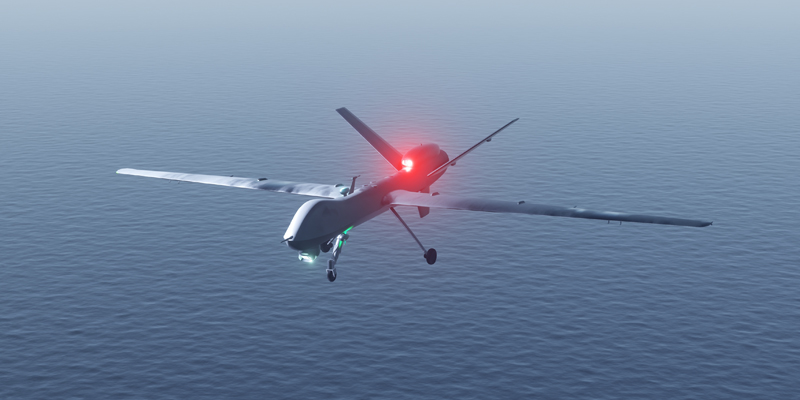
Autonomous systems are changing more than military operations. They are changing how defense products get designed, built, revised, and scaled.
In November 2024, the Department of Defense described the Replicator initiative's goal as fielding multiple thousands of all-domain, attritable autonomous systems. The Navy is pursuing a hybrid fleet combining traditional vessels with smaller, more numerous, widely distributed robotic platforms. Meeting that demand takes more than turning up the volume on an existing drone design.
Contractors now have to move from prototype to field test quickly, revise platforms as missions and threats shift, process a wider mix of advanced materials, and adjust output as orders move from limited batches to large production runs — often at once, and often on the same shop floor.
That combination is the real manufacturing challenge. Our new white paper, Meeting the Manufacturing Challenges of Military Autonomous Systems, examines it in depth. Here is the short version.
The Design Never Really Stops Changing
Traditional defense programs followed long development cycles, then production of a carefully controlled design. Autonomous systems increasingly do not.
The Defense Innovation Unit describes its Blue UAS program as a “continuous effort to prototype and scale secure commercial drone technology for military application,” built around interoperable components that let developers add capability as requirements change. The Government Accountability Office, reviewing Navy autonomous and robotics programs, found commercial development moving substantially faster than traditional military platform development, and recommended greater use of rapid, iterative methods.
For manufacturers that creates a stack of related problems: lightweight structures that still have to be strong and durable; geometry that shifts as sensors, radios, batteries, payloads, and protection evolve; a handful of test parts that may become an order for thousands; platform variants sharing a common structure but needing different physical interfaces; and cost pressure that makes it risky to tool up for a design that may not survive the next revision.
The challenge is not making one part accurately. It is moving from concept to prototype, test, early production, revision, and scale without rebuilding the manufacturing process at every step.
Because waterjet cutting follows digital cutting paths rather than fixed dies, revised geometry generally means a new program — not a new set of dedicated production tooling.
One Platform, a Lot of Different Materials
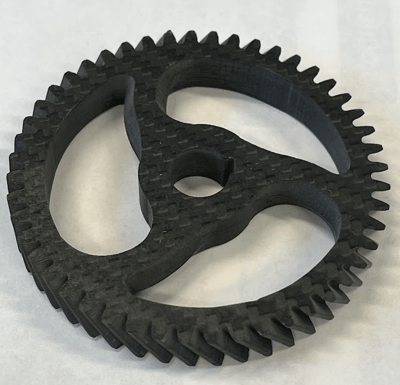 Weight, endurance, corrosion resistance, and payload capacity push autonomous designers toward a diverse material mix. A single small unmanned aircraft may combine carbon-fiber panels, aluminum structure, engineered plastics, foam, elastomeric seals, and titanium hardware. Ground, surface, and undersea platforms add thicker metals, corrosion-resistant alloys, and layered structures.
An abrasive waterjet cuts a virtually limitless range of hard and brittle materials like:
-
aluminum alloys
-
titanium
-
stainless steels
-
nickel-based superalloys
-
hardened metals
-
thick plate
-
ceramics
-
composites
-
carbon fiber
This is all done without material-specific saw blades, mills, dies, or thermal-cutting systems. Switch to water-only cutting and the same machine handles gaskets, rubber components, insulation, foam inserts, and protective layers.
Composites are a very interesting case. Manufacturing USA identifies composite manufacturing as a persistent constraint in aerospace and defense: labor-intensive, slow to modify, difficult to scale. Contact tooling brings tool wear, fiber pullout, fraying, airborne dust, and resin matrix damage. Waterjet removes the rotating tool and the thermal edge, and offers incredible advantages for low-to-no dust generation.
Process knowledge also plays a critical role – if appropriate parameters and techniques are not utilized for specialty materials, defects like delamination can occur. Having a supplier with both the knowledge and desire to support to enable your success is essential, and can help guide you is selecting piercing method, pressure, traverse speed, standoff distance, material orientation, and abrasive parameters, all of which can affect the result. The honest framing: a properly developed waterjet process reduces several problems associated with thermal and contact cutting, but there is not one-size-fits-all set of process parameters that can be used across every material. (The white paper goes deeper here, including abrasive waterjet machining of carbon-fiber and titanium stacks.)
Cold Cutting Protects What the Material Was Chosen For
Laser and plasma remove material with heat. The crucial downside is this can also cause a heat-affected zone, edge hardening, distortion, hot-cracking, recast material, oxidation, changes to nearby heat treatment, or thermal degradation in composites and laminates.
Waterjet performs incredibly precise material removal that doesn’t involves no melting, avoiding the conventional heat-affected zones associated with thermal cutting. That can have a huge impact on all kinds of relevant materials like aluminum, titanium, hardened alloys, and composites where thermal distortion or metallurgical change would affect downstream operations or component performance.
Waterjet can also significantly reduce secondary work: five-axis systems add bevels, chamfers, and taper compensation while producing a near-net profile, significantly reducing the grinding or machining required later.
Beyond the incredible diversity of materials it can produce, waterjet's value is in preserving specified material properties and handing compliant parts to the next operation.
Prototype Today, Production Run Next Quarter
For smaller defense technology companies, expensive hard tooling is a barrier during development. A design may change several times before anyone knows whether a production order will follow. Larger contractors face a version of the same problem: evaluating multiple configurations, folding in field feedback, supporting several variants from a common design.
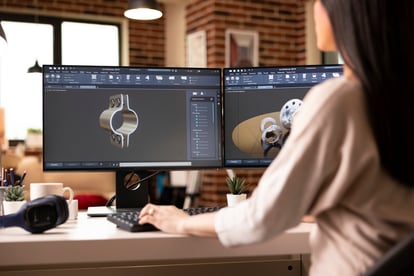 A waterjet cuts prototype and short-run parts directly from production-grade material — airframe and body panels, sensor brackets, antenna mounts, payload interface plates, battery trays, protective covers, enclosure panels, test fixtures, revised structural parts. Revise the geometry, run the new program. If the revision calls for a different material, the same machine will still be able to process it.
NIST describes a digital thread as “the flow of product-definition information between design, manufacturing, quality, and inspection,” and its research indicates model-based product definitions can reduce design-to-manufacturing time and improve part quality. A CNC waterjet participates in that workflow directly: revised geometry in, revised physical component out.
Scaling Without Getting Trapped
Replicator's announced target illustrates the scale DOD expects the industrial base to support. But that production challenge is rarely continuous runs of one unchanging part. It is several related designs, multiple materials, frequent engineering changes, short replenishment runs, sudden demand increases, and concurrent work across programs.
Waterjet production can be configured around those conditions through larger cutting tables, automated nesting, multiple cutting heads, independently controlled carriages, high-rail systems, automated material handling, and lights-out cutting.
It may not be the best choice for every application, but the unique attributes of the waterjet cutting process brings real advantages for manufacturers needing material versatility, thicker sections, composites, high-value alloys, short setup times, or continued design flexibility, and where near-net blanks reduce material loss and downstream machine time.
The Supply-Chain Question Underneath All of It
DOD's National Defense Industrial Strategy calls for more resilient supply chains, a broader supplier base, and stronger domestic manufacturing capacity. The scale of the problem is substantial: GAO reported in July 2025 that DOD estimated more than 200,000 suppliers contribute to advanced weapon systems, with limited visibility into the sources of many lower-tier parts and raw materials. In GAO's review of the MQ-9 Reaper, DOD mapped the prime contractor and three supplier tiers — while a separate analysis found Chinese supply involvement deeper in that chain.
Bringing cutting capability in-house reduces dependence on outside profile-cutting suppliers, shortens revision turnaround, gives control over urgent-part scheduling, limits distribution of sensitive designs, and supports several programs on one platform.
A waterjet does not by itself establish traceability, cybersecurity, or quality compliance. Those outcomes depend on controlled models, approved material sources, operator qualifications, inspection, calibration, documented processes, and secure data management. The machine supports supply-chain resilience when it operates inside that larger quality and digital-control system.
Where it Fits Alongside Everything Else
Waterjet complements other processes rather than replacing them. CNC machining still owns close-tolerance holes, threads, pockets, and finished surfaces — but machining an entire flat profile from solid plate burns machine time and wastes material when a waterjet can efficiently cut a nested near-net blank first. Laser remains highly productive for thin-metal parts and where heat input doesn’t matter; waterjet adds flexibility where material is thick, reflective, thermally sensitive, or nonmetallic. Additive excels at complex internal passages and topology-optimized shapes, less so at large flat panels already available in qualified plate. An optimized workflow uses each process for what it does best.
Talk To Jet Edge
Considering the Section 179 opportunity? We encourage you to talk to a Jet Edge representative about system configurations, lead times and when you can realistically expect to place your water jet in service. Like we said, we know water jets and how we can help meet Section 179 in-service requirements. Your finance and tax professionals will handle the tax portion.
Call us at 1-800-538-3343 (1-763-497-8700 internationally) or complete our online form today. Our skilled and experienced application engineers are here to help.
Check Out Our Digital Brochure!
Since 1984, Jet Edge has been designing and manufacturing Ultra-High-Pressure Water jet technology that doesn't back down. Our systems are used around the world in a broad range of industries from the world's leading airlines, to automotive, aerospace and industrial manufacturers, and machine job shops.
To learn more about the Jet Edge difference, our water jet motion systems, pumps and much more, click the button "Download Brochure" to get it now!

%20-%20Jet%20Edge%20Waterjets.png "A Blog About our Blog Button (revised) - Jet Edge Waterjets")