
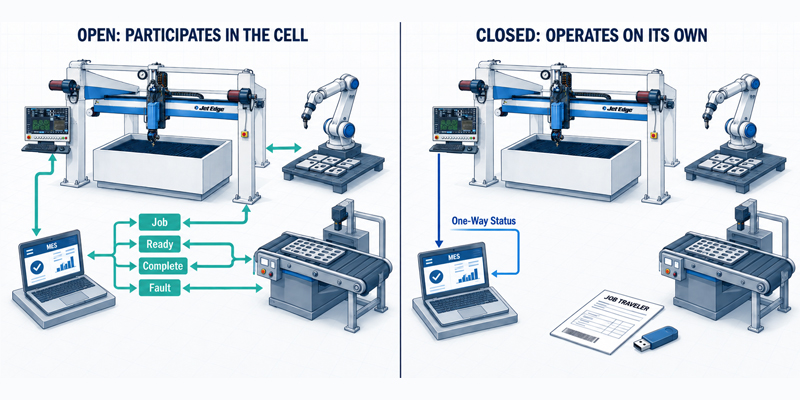
Companies producing high-precision parts, whether in small batches or continuous runs, want to integrate their cutting systems into broader, automated production processes. The reason is simple: global competition is forcing companies to cut every ounce of inefficiency from their operations, from the cutting floor to their enterprise resource planning (ERP) systems.
So, a cutting tool that is smart enough to operate unattended once the cut job program is fed into the controller should slip effortlessly into a tightly integrated production cell, right? Unfortunately, that is not the case. On-board intelligence doesn’t automatically translate into system intelligence. Each machine must be able to exchange meaningful information and permitted commands with the equipment and systems around it. Many otherwise sophisticated machines cannot.
The limitation often traces back to a purchasing decision made years earlier, when the control system appeared as a single line on a specification dominated by cutting speed, accuracy and price. The Open Machine concept addresses that overlooked limitation.
Industry 4.0 and the Open Machine
Before digging deeper into the importance of Open Machine capability, let’s put it into perspective against the broader automation initiative called Industry 4.0.
As the following graphic illustrates, Industry 4.0 seeks to connect physical production with manufacturing and business systems so information can support coordinated, increasingly automated operations.
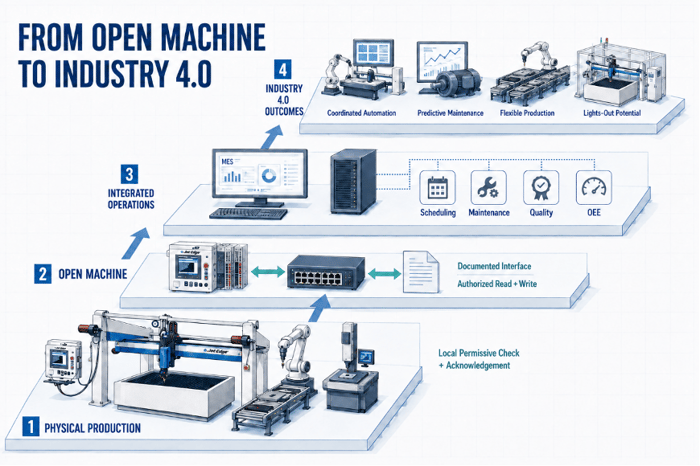
The key to full Industry 4.0 automation is the Open Machine, the machine-level foundation of a fully connected production operation.
So, let’s explore what the Open Machine is, what it does, and how you can turn your water jets into Open Machines.
Defining the Open Machine
Defining an Open Machine precisely matters because the term is used loosely in equipment marketing and can be confused with related concepts such as open architecture, connectivity, and interoperability. These concepts overlap, but they are not interchangeable.
For purposes of this post, we offer the following definition:
An Open Machine provides documented, secure, and supportable interfaces through which authorized external systems can obtain meaningful operating information and, where appropriate, issue permitted commands without requiring the OEM to engineer every connection.'
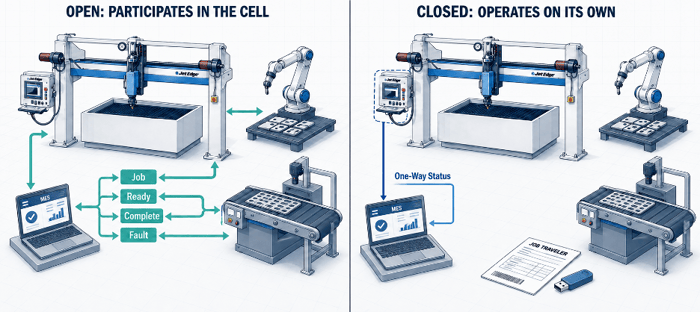
What does this mean to you and your operations? Here is how that definition translates to the production floor:
- Documented external access pathways
- Controlled read access and permitted write functions
- Information collection provided with context
- Independent, supportable integration
- Security controls and permissions
- Lifecycle support
The Closed-System "Tax"
Operations moving from islanded machines to integration and automation invariably face what you could call a closed-system tax. It’s not a tax in the sense that some government entity demands and collects it. It reflects the costs associated with turning stand-alone machines into open machines.
But you invested in smart machines boasting connectivity. They’ve operated well for years, accepting and executing part machining programs and sending data to the vendor-supplied dashboard. Why are they so expensive to upgrade to an open machine now?
- Integration cost inflation: Every connection to a closed machine requires custom middleware, a vendor engagement, or a license.
- Manual bridging between systems: This cost shows up as an operator retyping job data or babysitting a machine that can’t signal upstream.
- Blocked functional enhancements and upgrades: This opportunity cost shows up when you can’t add a robot loader, a vision check, or a conveyor handoff because the machine can’t be commanded or can’t report "ready."
- Data you can’t collect: Your closed machine limits the types of data provided, meaning you miss valuable O&M information like cycle counts, consumable wear, fault history sitting inside a controller you own but don’t actually have the keys to.
- Exit cost: The costs of switching or replacing the machine include rebuilding and reconfiguring everything you bolted onto it.
- Lost future flexibility: A plant can’t forecast what future automation, reporting, maintenance, or integration it’ll face in three, five, or ten years when it purchases a future machine. The open interfaces preserve that flexibility, whereas closed systems limit it.
The best way to avoid this tax in the future is to ask the right questions of vendors and write the specification so your machine comes through the door as “open machine ready.”
You don’t pay the closed-system tax at purchase. You pay it every year afterward, in increments so small nobody attributes them to the original decision.
Here's What Openness Unlocks for Your Operations
Moving to an open machine can unlock a wealth of control, operational data, automation opportunities, and much more. The following four capability tiers span the spectrum from first steps to Industry 4.0.
1. Visibility.
Machine states, cycle counts, consumable wear and fault histories can flow into the systems your plant already uses, supporting evidence-based OEE, throughput analysis and maintenance decisions.
2. Coordination.
A machine signals "done," and the next machine acts on that notification, while new job data flows down from the ERP to the now-available tool.
3. Integration into a line.
Machine-controlled robot loading and unloading, conveyor handoffs and in-line inspection made possible with write access and reliable handshaking.
4. Customization the OEM never shipped.
In a closed system, the OEM must approve and agree to create and or support custom features.
The value wasn’t in the feature. It was in being allowed to build it with your staff or trusted suppliers.
Lights-Out Cutting
Let’s look at the example of lights-out cutting. This approach allows a manufacturer to operate virtually around the clock, unattended. It can add more shifts without hiring additional staff or incurring overtime, boosting output. But there is a catch. Stand-alone lights-out cutting and machining is often limited by the inability to offload finished parts or reload material when it runs out.
Imagine the flexibility and productivity possible in a lights-out scenario when open machines are integrated into a fully automated process: a cutting tool, say a water jet, is loaded with stock before everyone goes home for the night, weekend, or holiday, then turned on.
When cutting is finished, the water jet communicates over the network that it is done. At this point, an automated conveyor offloads and moves the finished parts. Once the material is positioned and all local operating and safety conditions are satisfied, the machine accepts the next cycle request.
How TwinCAT and ADS Enable Openness
Let’s look at two parts of a proven open solution: Beckhoff’s “The Windows Control and Automation Technology” (TwinCAT) platform and Automation Device Specification (ADS).
Beckhoff TwinCAT
TwinCAT is a software suite that provides PLC logic, motion control, CNC, robotics, safety, and communications stacks. A Beckhoff IPC or any Windows PC suitable for an industrial environment serves as the controller that enables open machine capabilities. Windows handles the UI and non-critical tasks, while TwinCAT handles real-time control and communication functions.
TwinCAT enables a variety of enabling system actions and capabilities, including:
- Runs IEC 61131‑3 PLC programs (ST, LD, FBD, etc.).
- Provides motion control (NC, CNC, robotics).
- Supports C/C++ real‑time modules and MATLAB/Simulink integration.
- Hosts multiple runtime instances (PLC + NC + CNC + robotics simultaneously).
Automation Device Specification (ADS)
ADS is Beckhoff’s communication protocol for exchanging data among TwinCAT components and authorized external applications. Through documented Beckhoff and third-party client libraries, an integrator can read exposed machine variables, subscribe to changes and, where the machine builder permits it, write values or submit operating requests.
ADS client libraries exist for C#/.NET, Python, Node.js, Java, and C++ on Linux. This means that your existing software has a good chance of reading a variable off the machine and writing one back. And that’s the trick.
ADS' Role in the Protocol Landscape
Think of Ethernet/TCP/IP as the road. The protocol carries the message. The interface or information model supplies the vocabulary. Handshake logic supplies the rules of conversation.
Below is an abbreviated overview of common manufacturing protocols:
- ADS: Direct, Beckhoff-specific access to TwinCAT data and functions.
- OPC UA: Vendor-neutral interoperability, information modeling, security, events, history, and permitted commands.
- MTConnect: Structured manufacturing-equipment information, generally through a read-only interface suited to monitoring.
- MQTT: Lightweight publish/subscribe transport; it carries payloads but does not by itself define manufacturing meaning.
- EtherCAT and similar fieldbuses: Deterministic machine-level communication among controls, drives, I/O, and devices; not automatically a plant or enterprise interface.
Openness isn’t a feature bolted onto the control system. It’s an inherent consequence of the control system’s architecture.
Open Does Not Mean Exposed
Implementing an open machine approach in your operation does NOT mean unsecured exposure, or create IT / security risks. Manufacturing process security combines documented access with segmentation, authenticated and encrypted communication, least-privilege permissions, monitoring, and safety functions that remain authoritative over external (read: hacker or unauthorized) requests.
- Use defense in depth: Separate IT and operational-technology networks; segment cells; control boundaries with industrial firewalls and an OT DMZ.
- Constrain communications: Permit only required devices, ports, protocols, and directions; authenticate clients; encrypt where appropriate; distinguish read from write; and apply least privilege.
- Control and observe/log access: Use VPNs, multifactor authentication, jump hosts, time limits, approval, and logging for remote access; harden and patch systems; monitor abnormal traffic and configuration changes; preserve tested offline backups.
- Keep the risk comparison honest: A disconnected machine generally has a smaller remote attack surface, but proprietary or opaque architecture alone is not a security model and does not guarantee that a connected machine is protected.
Openness Also Doesn't Mean Plug-and-Play
Openness does not mean a controller uses open-source software, defaults to unrestricted access, exposes the machine to the internet, guarantees automatic compatibility, plug-and-play integration, or avoids proprietary technology. Open systems cooperate only when commands, acknowledgments, timing, exceptions, and recovery are meticulously defined, not merely because an Ethernet cable connects them.
Open architecture makes integration possible and supportable, but it does not make integration automatic.
Crucial Safety Considerations
In traditional IT systems, the primary threat to employees and operations comes from data loss or corruption. However, in a manufacturing process, compromised safety controls can lead to serious injury, death, and damage to equipment and facilities.
Note: We offer these suggestions as a starting point. Coordinate with your safety and legal teams to develop plant-specific rules.
- External commands remain subordinate: Local operating permissives and certified safety functions remain authoritative over any network request.
- Describe networked start as a request: The machine executes its program only when all required operating and safety conditions are satisfied.
- Separate lockout/tagout (LO/TO) from network safety: LO/TO is a physical and procedural hazardous-energy isolation practice for servicing; it is not the cybersecurity or operating-safety layer being discussed here.
Caveat Emptor
Many vendors advertise their controllers as offering “connectivity.” In practice, this amounts to a vendor-hosted dashboard and a data feed the vendor controls. That is a window into the machine, not a secure path through which authorized systems can interact.
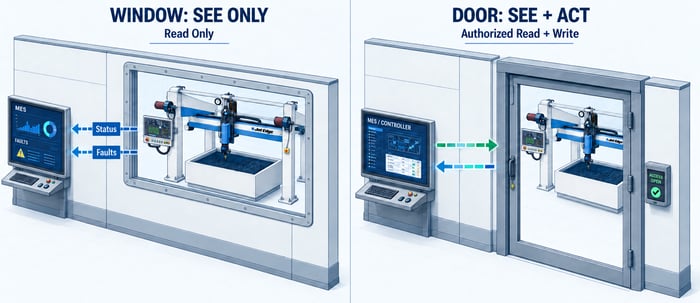
Your best defense is to ask the right qualifying questions so that you can separate marketing claims from actual system performance. Four sample questions follow with a full set of 12 in the Appendix:
-
What protocol or API is available for external communication, and can we review the documentation before purchase?
-
Can external systems write permitted values or requests, or only read status?
-
Which variables, states, events, and functions are exposed, and is there a published interface or tag list?
-
Can our independent integrator or staff use the interface without compromising support or warranty?
Remember, a vendor confident in their architecture and solution capabilities will answer these questions, engaging their engineering support as needed.
Jet Edge Builds water jets for Open Integration
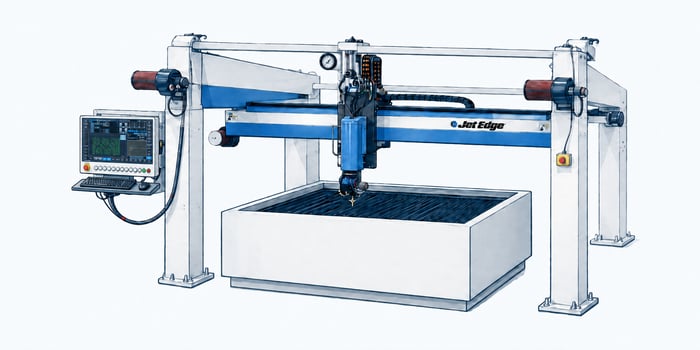
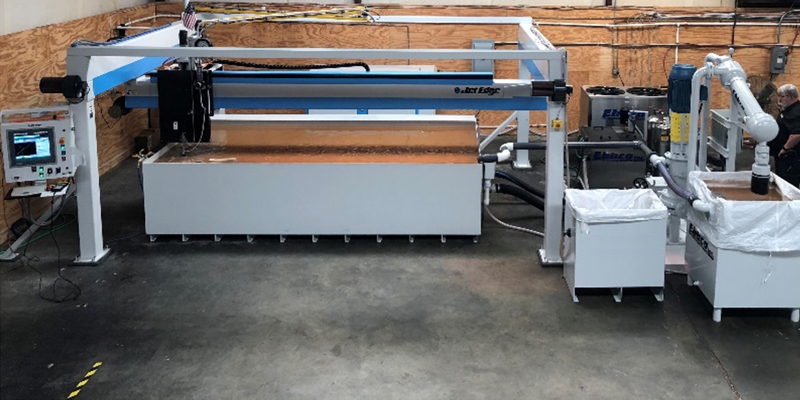
Jet Edge builds its water jet systems on Beckhoff TwinCAT technology to give customers open, ADS-based access. Customers integrate Jet Edge water jets into automated lines and their own software because we chose an architecture that allows it.
The concept of an open machine isn’t a Jet Edge-only idea. The entire manufacturing economy is moving toward Industry 4.0, and the open machine is the required first step in that evolution. It is a principle worth applying to every machine on the floor, new and existing.
Talk To Jet Edge
We encourage you to talk to a Jet Edge representative about system configurations, lead times and when you can realistically expect to place your water jet in service. Like we said, we know water jets and how we can help meet Section 179 in-service requirements. Your finance and tax professionals will handle the tax portion.
Call us at 1-800-538-3343 (1-763-497-8700 internationally) or complete our online form today. Our skilled and experienced application engineers are here to help.
Appendix
Here are twelve questions to ask every vendor, including Jet Edge, in order to separate marketing language from true capabilities.
- What protocol or API is available for external communication, and can we review the documentation before purchase?
- Can external systems write permitted values or requests, or only read status?
- Which variables, states, events, and functions are exposed, and is there a published interface or tag list?
- Does access cost extra, require another license, or require an OEM service engagement?
- What is the underlying control platform—standard industrial PC and supported software, or proprietary hardware?
- Can our independent integrator or staff use the interface without compromising support or warranty?
- How are data meanings, units, state definitions, commands, and acknowledgments documented?
- How are clients authenticated, communications secured, and read/write permissions restricted?
- How are interface versions, software updates, and backward compatibility managed?
- What happens when communications fail, time out, or deliver an invalid request?
- Who owns the machine-generated data, and can we retrieve it without a vendor cloud service?
- Can you provide a reference example of the machine operating in an automated cell or integrated production system?
Check Out Our Digital Brochure!
Since 1984, Jet Edge has been designing and manufacturing Ultra-High-Pressure Water jet technology that doesn't back down. Our systems are used around the world in a broad range of industries from the world's leading airlines, to automotive, aerospace and industrial manufacturers, and machine job shops.
To learn more about the Jet Edge difference, our water jet motion systems, pumps and much more, click the button "Download Brochure" to get it now!


%20-%20Jet%20Edge%20Waterjets.png "A Blog About our Blog Button (revised) - Jet Edge Waterjets")